
Built a personal AI assistant that runs on a Mac mini and answers from one local index of texts, email, photos, files and calendar.
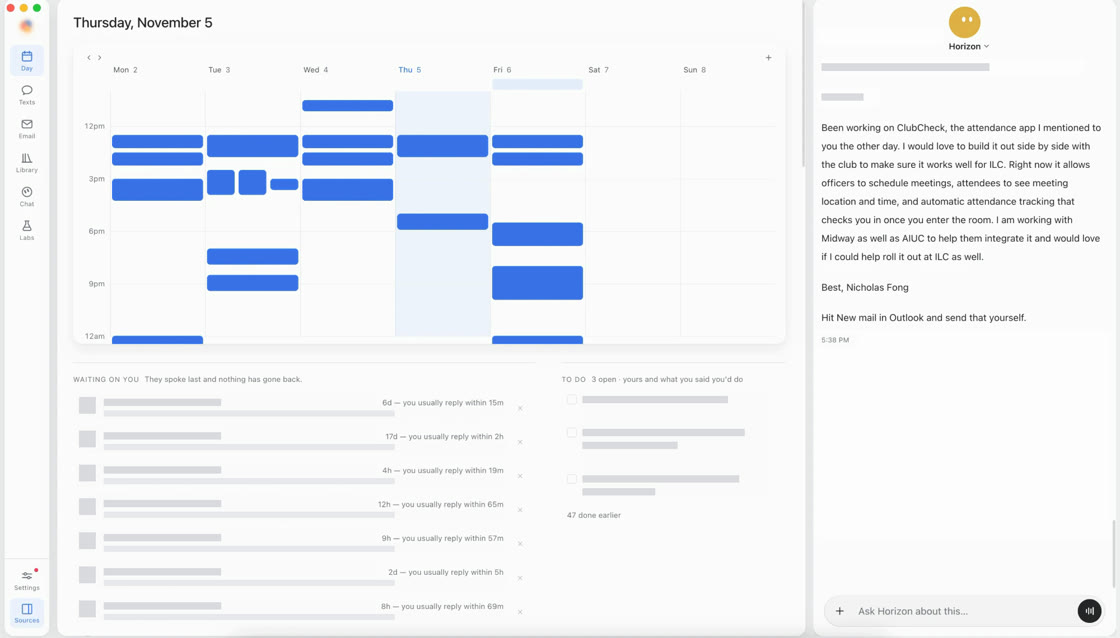
Everything runs on the Mac mini. The laptop and phone are windows onto it. The laptop app is a browser window pointed at the mini over Tailscale, a private network between my own devices, and the phone app is a web app on the home screen.
One index, and one person per person
The index is one SQLite file, a database that lives in a single file, with full-text search over texts, mail, photos, Drive files, calendar and contacts. I tested DuckDB for this and it lost: its full-text index is a snapshot, so a message that arrived after the build stayed invisible until a full reindex.
Every number, address and handle someone uses gets merged into one person, but only on evidence. Each link records where it came from, so a wrong merge can be undone. Photos are searched through the labels macOS already computed on the device, so no picture leaves the Mac.
Answers you can check, and sends that need a person
Agents search and read the index through read-only tools, which can’t write, delete or send. Every claim links to the exact message it came from, and replies go only into existing threads, after two presses. No field anywhere takes a phone number, so the worst case is the wrong friend, never a stranger.
Personal data reaches a model through one route, which asks only for providers that don’t train on it and don’t keep it. Claude Code and Codex can’t use that route, because they connect straight to their own companies, so the app says so at the point where you pick them.
Each chat gets its own browser tabs
Each chat drives its own tabs in a headless Chrome on the Mac mini, meaning a Chrome with no window, streamed live to laptop and phone; from the laptop you can take over at any point. Agents can browse, search and fill in ordinary fields by themselves. Email, DMs, posts and follows get handed to a person to press, and agents never enter passwords, codes or payment details.
| Browser limits in the code | |
|---|---|
| Pages, at most | 12 |
| Chats with pages, at most | 8 |
| Pages per chat, at most | 4 |
| After a person’s input, the view stays on that tab for | 15 s |
Agents that keep their place
An agent’s context is everything it can see in a conversation. When that fills up, the tool squeezes it down, which is called compaction, and details get lost. I used stateful agents to reduce the effects of context compaction: one live session per chat, resumed after restarts, and only what changed sent each turn.
If a session really is lost, the app retells it: up to the last 16 turns, each cut to 1,500 characters, with a note telling the agent to look things up again instead of repeating old claims as if it had just checked them. Every night at 3:00, a job also rewrites one small memory file that each agent reads when it starts. The file has hard size limits. A night that goes over is refused and yesterday’s file stays, and seven dated versions are kept in case a night goes badly.
I also built stateful subagents: the usual subagent does one task and vanishes, and these stay. Each is a named job with its own model and its own session, saved after every answer and resumed after a restart, so a new brief can be short because what it already did is still on its side. A person approves each hire on a card, a parent gets seven at most, and a subagent can’t hire. Extra briefs wait in line, one at a time, a restart picks up whatever is left, and a failed job goes back to the front until someone retries it, because its tools may already have changed files.
Chrome looked healthy and wasn’t
On September 1, 2026, Chrome had been up for six days when the connection used to steer it stopped answering. The process still looked healthy, so nothing raised an alarm while the live view and the agents’ controls were dead. The check now asks Chrome to answer over that connection, and two failed checks restart it.